
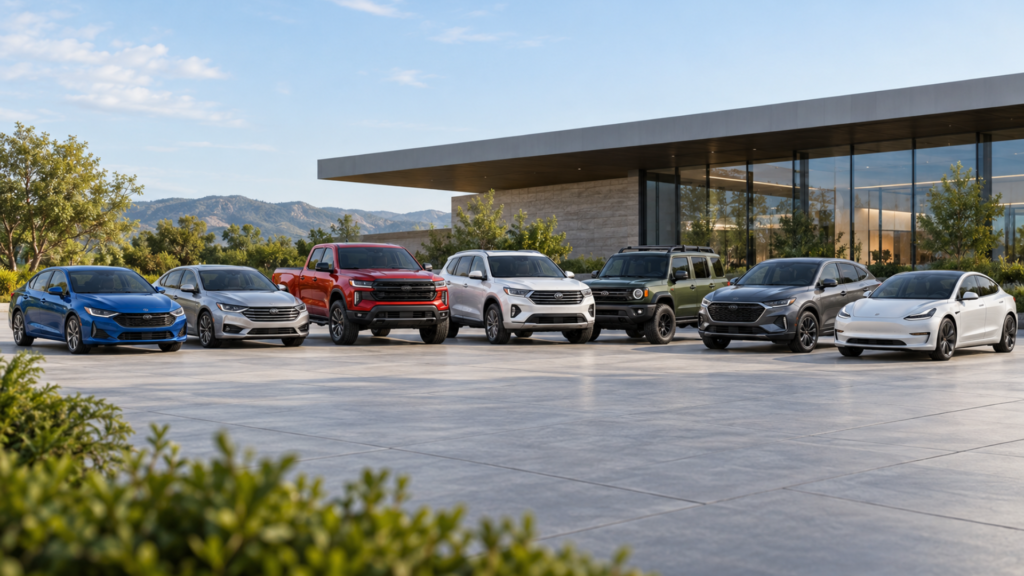
The automotive market includes manufacturers with very different histories, technologies, and vehicle lineups. Understanding some of the best-known car brands in the United States can help drivers recognize what each company generally emphasizes.
This overview does not rank the brands or recommend one specific manufacturer. Vehicle quality, equipment, reliability, and ownership costs can vary by model, year, condition, and maintenance history.
1. Toyota: a broad and diversified lineup
Toyota offers compact cars, sedans, SUVs, pickup trucks, minivans, hybrids, plug-in hybrids, and battery-electric vehicles. Models such as the Corolla, Camry, RAV4, Highlander, Tacoma, and Tundra represent several different areas of the market.
The brand has also developed an extensive selection of hybrid vehicles. Drivers interested in its current lineup can consult the official Toyota vehicle website.
2. Honda: cars, SUVs, and practical transportation
Honda is associated with passenger cars and family-oriented vehicles. Its lineup includes sedans, hatchbacks, SUVs, a pickup truck, a minivan, hybrids, and electric options.
Vehicles such as the Civic, Accord, CR-V, Pilot, Passport, Ridgeline, and Odyssey serve different types of drivers. Honda’s official vehicle lineup page provides current model information.
3. Ford: trucks, SUVs, performance, and electrification
Ford has a strong presence in the truck and SUV segments. Its lineup includes vehicles designed for commuting, family use, commercial work, towing, off-road driving, and performance.
The company also offers hybrid and electric vehicles alongside conventional gasoline-powered models. Current categories can be reviewed on the official Ford website.
4. Chevrolet: vehicles across multiple categories
Chevrolet produces compact SUVs, larger family SUVs, pickup trucks, performance vehicles, commercial vans, and electric models. This variety allows the brand to participate in several areas of the U.S. automotive market.
Its lineup includes familiar model families such as Equinox, Traverse, Tahoe, Colorado, Silverado, and Corvette. The available selection changes over time, so consult the official Chevrolet lineup for updated information.
5. Jeep: SUVs and off-road-oriented vehicles
Jeep is primarily associated with SUVs, four-wheel-drive capability, and outdoor-oriented vehicles. Its range includes compact crossovers, family SUVs, off-road models, and a pickup truck.
Wrangler and Gladiator emphasize rugged capability, while Compass and Grand Cherokee serve different everyday and family needs. The official Jeep lineup page shows its current vehicle categories.
6. Subaru: all-wheel-drive cars and crossovers
Subaru is known for using all-wheel drive across much of its lineup. The company offers sedans, sports cars, crossovers, family SUVs, hybrid vehicles, and electric options.
Models such as Crosstrek, Forester, Outback, and Ascent are designed for different passenger and cargo requirements. Visit the official Subaru vehicle page to review the current lineup.
7. Tesla: vehicles designed around electric power
Tesla differs from many traditional manufacturers because its passenger vehicles are built around battery-electric powertrains. Its lineup includes sedans, crossovers, larger vehicles, and a pickup truck.
Charging access, driving range, insurance, repair options, and home-charging requirements are important considerations for any electric vehicle. Current Tesla vehicles can be reviewed on the official Tesla website.
How should car brands be compared?
A brand’s general reputation is only a starting point. When comparing vehicles, examine the exact model and year instead of making a decision based only on the badge.
- Vehicle size and passenger capacity.
- Fuel type and estimated efficiency.
- Safety equipment and crash-test information.
- Maintenance and repair requirements.
- Insurance costs.
- Warranty coverage.
- Availability of qualified service centers.
- Vehicle history and physical condition when buying used.
If you are considering a pre-owned model from any manufacturer, read our guide on how to inspect a used car before buying.
Final thoughts
These seven car brands in the United States represent different approaches to transportation. Some maintain broad lineups, while others concentrate more heavily on trucks, off-road vehicles, all-wheel drive, hybrids, or electric power.
The most suitable choice depends on the individual vehicle, intended use, budget, local conditions, and ownership requirements. Always compare specifications and independently verify current information before making a purchase.
Informational notice: This independent article is provided for general educational purposes. It is not affiliated with, endorsed by, or sponsored by any vehicle manufacturer, and it does not sell vehicles or provide purchasing, mechanical, financial, or legal advice. Brand names belong to their respective owners.