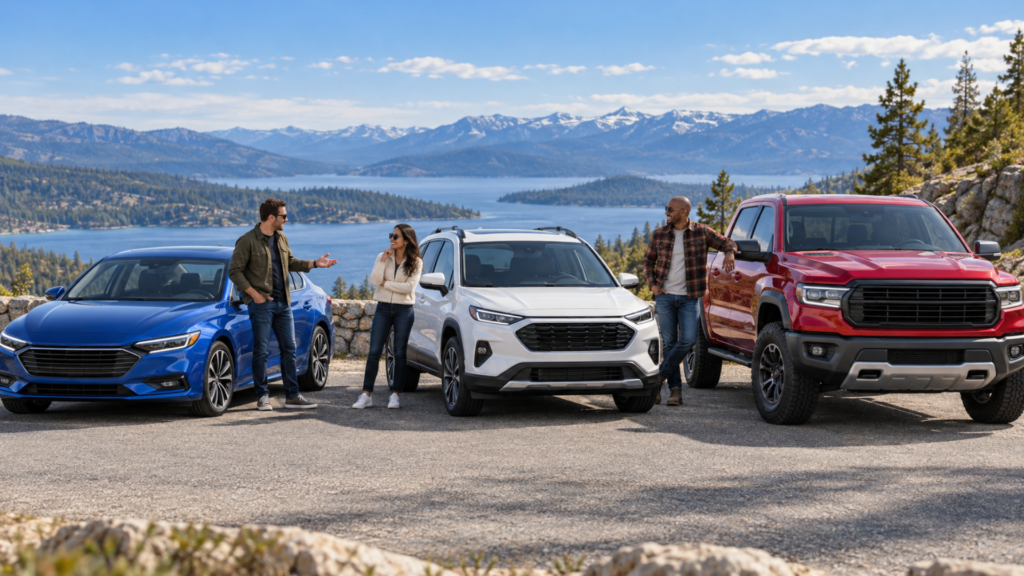
Toyota, Honda, and Ford are three familiar automotive brands in the United States, but they do not serve every driver in exactly the same way. Each offers different vehicle types, powertrains, features, and driving experiences.
This Toyota vs. Honda vs. Ford comparison does not declare one universal winner. Instead, it explains what to consider when deciding which brand may fit your daily driving, family needs, work requirements, and lifestyle.
Start With a Job the Vehicle Must Do
Use the three brands to find candidates for one defined need, rather than assigning a winner to each badge. A compact SUV shortlist for commuting raises different questions from a pickup shortlist for carrying equipment.
Toyota: Specify Which Electrified Option You Mean
When considering a Toyota, distinguish a hybrid, a plug-in hybrid and a battery-electric candidate before comparing costs. Check the exact model year, trim and drivetrain before comparing specifications. The 2026 RAV4 example below shows why even a drivetrain choice changes a specification within one model.
Honda: Check the Trim and Daily Fit
For a Honda candidate, verify which powertrain and equipment belong to the selected trim on the U.S. vehicle pages. Assess passenger access, cargo and parking against your routine. A general description such as “practical family car” is not evidence that your child seats or work equipment fit.
Ford: Separate Utility Requirements From Appearance
For a Ford candidate, identify the task that calls for its equipment. Check the specific model’s documentation for drivetrain, cargo and any required towing configuration. An SUV or truck appearance does not establish sufficient load capacity or the need for that vehicle in the first place.
Quick Toyota vs. Honda vs. Ford Comparison
| Brand | Common Strength | Worth Exploring For |
|---|---|---|
| Toyota | Broad variety of vehicle types and powertrains | Commuting, family use, hybrids, SUVs, and trucks |
| Honda | Cars and crossovers suited to everyday use | Daily driving, city use, families, and hybrid options |
| Ford | Trucks, SUVs, utility vehicles, and electrified choices | Work, towing, cargo, recreation, and larger vehicles |
This overview describes general differences rather than guaranteeing that every model from a brand will have the same qualities.
A Concrete 2026 SUV Shortlist
U.S. manufacturer information checked October 18, 2026. These are research candidates with different powertrains, not a ranked road test.
| Candidate | Verified configuration detail | What to compare next |
|---|---|---|
| 2026 Toyota RAV4 Hybrid | Hybrid output is 226 net combined horsepower with FWD or 236 with AWD. | Select the exact trim and drivetrain before comparing price and fuel economy. |
| 2026 Honda CR-V Sport Hybrid | A hybrid trim in a lineup that also includes non-hybrid versions. | Keep the hybrid and drivetrain choice consistent across quotes; check the model-specific equipment list. |
| 2026 Ford Bronco Sport Big Bend | 1.5-liter EcoBoost engine and standard 4×4. | Compare the equipment and actual intended use; this is a different powertrain proposition from the two hybrids. |
Sources: Toyota’s 2026 RAV4 announcement, Honda’s 2026 CR-V specifications, and Ford’s Bronco Sport Big Bend information.
Get insurance quotes for the specific vehicles and run the same annual mileage through the ownership cost calculator. A horsepower figure or brand badge cannot settle comfort, reliability, cargo fit, or overall value.
Compare the Vehicle, Not Just the Brand
Use our guide to comparing car brands to build a shortlist, then check vehicle-specific safety ratings for the exact model year and version.
A brand name can help you create a shortlist, but the individual vehicle matters more. Two models from the same manufacturer may differ significantly in size, safety technology, fuel economy, performance, comfort, and ownership expenses.
Before making a decision, compare vehicles from the same category and model year. A compact sedan should not be evaluated against a full-size pickup truck because they are designed for different purposes.
Questions to Ask Before Choosing
- How many passengers do you normally carry?
- Will the vehicle be used mainly in the city or on highways?
- How much cargo space do you actually need?
- Do you need towing or off-road capability?
- Can you conveniently charge an electric or plug-in hybrid vehicle?
- What are the expected insurance, fuel, maintenance, and repair costs?
- Are local service centers and replacement parts readily available?
New and Used Vehicles Require Different Research
For a used example, check its history before arranging a test drive and independent inspection.
When shopping for a new vehicle, compare the warranty, safety equipment, specifications, and included features of the exact trim level. Optional equipment can significantly change a vehicle’s final configuration.
For a used vehicle, its history and condition may be more important than the reputation of the badge. Review maintenance records, check the vehicle history, look for open recalls, and arrange an independent pre-purchase inspection.
Take a Meaningful Test Drive
A test drive should reflect your real routine. Check visibility, seat comfort, controls, braking, acceleration, cabin noise, parking ease, and rear-seat access. If possible, drive on streets similar to those you use regularly.
Families should verify that child seats, passengers, and everyday cargo fit comfortably. Drivers considering trucks should confirm that the vehicle’s documented payload and towing ratings match their actual requirements.
Make the Shortlist Evidence-Based
Keep a candidate only after it meets the non-negotiable passenger, cargo, route and energy requirements. Then compare written prices, insurance quotes and ownership assumptions. If one fact is missing, mark it as unknown and obtain the document or test-drive observation; do not replace it with a brand’s reputation.
This article provides general automotive information and does not recommend or endorse a particular manufacturer or vehicle. Models, features, specifications, and availability can change. Verify current information with the manufacturer and consult qualified automotive professionals before making a purchase.