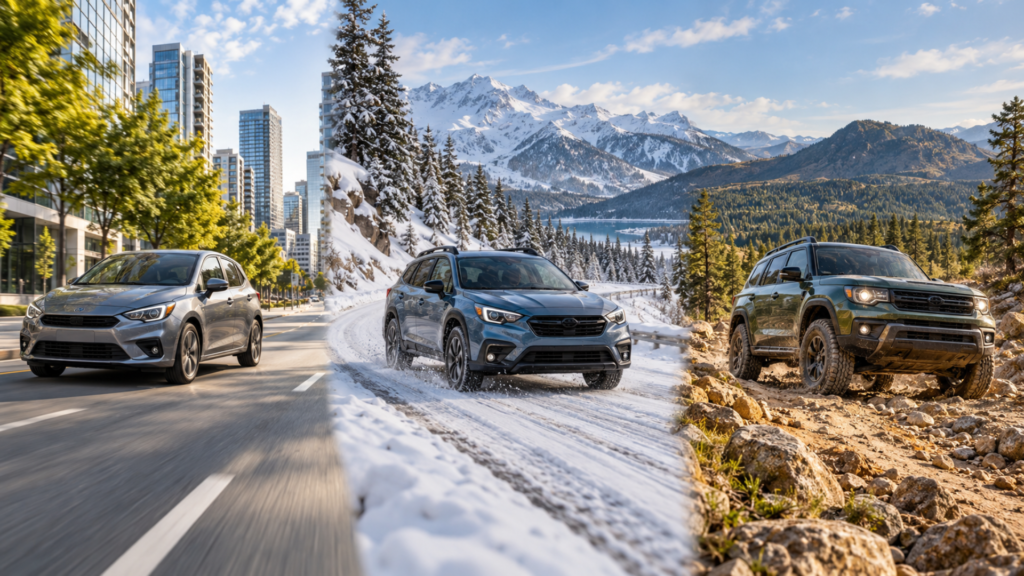
Comparing AWD vs 4WD vs FWD can be confusing because all three describe how engine or motor power reaches a vehicle’s wheels. However, they are designed for different driving conditions and can affect traction, fuel economy, maintenance, price, and capability.
The best system is not automatically the one that powers the most wheels. The right choice depends on your climate, roads, driving habits, towing needs, and whether you genuinely travel away from paved surfaces.
Quick Drivetrain Comparison
| System | Typical use | Main limitation | Check before buying |
|---|---|---|---|
| FWD | Maintained roads and everyday commuting | Less ability to distribute acceleration traction across axles | Tires, load, road conditions and actual fuel economy |
| AWD | Changing traction on paved roads | Does not by itself shorten braking distance or guarantee off-road capability | Tire matching, extra service, ground clearance and permitted use |
| 4WD | Demanding terrain when the vehicle is equipped for it | Some locked part-time modes are unsuitable for dry pavement | Owner’s manual, low range, mode restrictions and maintenance |
Towing capacity comes from the vehicle’s documented ratings and equipment, not an AWD or 4WD badge alone.
What Is Front-Wheel Drive?
Front-wheel drive, or FWD, sends power to the front wheels. Those wheels are responsible for pulling the vehicle forward while also performing most of the steering.
FWD is commonly found in sedans, hatchbacks, minivans, and compact crossovers. Its relatively simple and compact design can help reduce vehicle weight, mechanical complexity, and manufacturing cost.
Advantages of FWD
- Suitable for everyday city and highway driving.
- Often less expensive than an equivalent AWD version.
- May provide better fuel economy when comparing similar models.
- Generally has fewer drivetrain components to maintain.
- Can provide reasonable traction in rain and light snow with appropriate tires.
Possible FWD Limitations
The front tires must handle acceleration, steering, and much of the braking load, so they may wear differently from the rear tires. FWD can also have difficulty gaining traction in deep snow, loose sand, mud, or steep unpaved conditions.
For many drivers who stay on maintained roads and live in moderate climates, FWD may provide all the capability they regularly need.
What Is All-Wheel Drive?
All-wheel drive, or AWD, can send power to both the front and rear wheels. Some systems operate continuously, while others normally drive one axle and automatically transfer power when additional traction is needed.
Modern AWD systems may monitor wheel speed, steering angle, throttle position, and other information to adjust torque distribution. The exact operation varies considerably among manufacturers and models.
Advantages of AWD
- Additional traction when accelerating on wet, snowy, or loose surfaces.
- Automatic operation in many vehicles.
- Useful for drivers who encounter changing weather frequently.
- Widely available in cars, crossovers, minivans, and SUVs.
- Can improve confidence when starting on slippery hills.
Possible AWD Limitations
AWD adds mechanical or electrical components, which may increase weight, purchase price, and maintenance requirements. Fuel-economy differences depend on the design, so compare the official EPA estimates for the exact FWD and AWD versions under consideration.
Not every AWD vehicle is intended for serious off-road use. Ground clearance, tires, suspension, underbody protection, and cooling systems also affect off-road capability.
What Is Four-Wheel Drive?
Four-wheel drive, or 4WD, is commonly associated with trucks and rugged SUVs. Traditional systems use a transfer case to deliver power to the front and rear axles.
Some vehicles allow the driver to select modes such as:
- 2H: two-wheel drive for normal paved-road operation.
- 4H: four-wheel drive for loose, snowy, muddy, or slippery surfaces.
- 4L: low-range four-wheel drive for slow travel over particularly difficult terrain.
Not every 4WD vehicle includes all these settings. Newer systems may also offer an automatic mode or terrain programs that manage the drivetrain electronically.
Advantages of 4WD
- Designed for demanding off-road conditions.
- May include low-range gearing for slow-speed control.
- Useful in deep snow, sand, mud, rocks, and steep terrain.
- Commonly paired with vehicles intended for towing or heavy-duty use.
Possible 4WD Limitations
Traditional 4WD systems may add weight, complexity, and fuel consumption. Some part-time systems should not be used on dry pavement when the front and rear axles are mechanically locked together because drivetrain binding may occur.
Always read the owner’s manual before selecting a 4WD mode. The correct setting and maximum operating speed vary by vehicle.
AWD vs 4WD vs FWD in Snow
Check tire specifications and sidewall markings as well as drivetrain type; tires and road conditions remain essential to grip.
AWD and 4WD can help a vehicle begin moving or continue climbing when the surface is slippery. However, powering additional wheels does not automatically shorten braking distances.
Every drivetrain depends on the tires for acceleration, steering, and braking. A vehicle with appropriate winter tires may perform more predictably in winter conditions than one using tires unsuitable for low temperatures or deep snow.
NHTSA’s winter-driving guidance advises drivers to check tire pressure, tread condition, and weather suitability when preparing for winter travel. Drivers must still reduce speed and increase following distance, regardless of drivetrain.
Fuel Economy and Maintenance
FWD is often the lightest and mechanically simplest option. AWD and 4WD may require additional driveshafts, differentials, couplings, motors, or a transfer case.
Those components can affect fuel use and create additional service requirements. However, modern systems vary significantly, and some disconnect unused components to reduce energy losses.
When comparing vehicles, examine the EPA fuel-economy estimates for the exact engine, transmission, drivetrain, wheel size, and model year. Do not assume every AWD vehicle has the same fuel-economy penalty.
AWD and 4WD vehicles may also be sensitive to differences in tire size or tread depth. Follow the manufacturer’s instructions for tire rotation and replacement, especially when replacing fewer than four tires.
Which Drivetrain Fits Your Needs?
Choose FWD if:
- You primarily drive on maintained city streets and highways.
- Your area experiences mild weather.
- Lower purchase and operating costs are priorities.
- Your normal routes do not require low-range gearing or capability beyond the specific vehicle and tires.
Consider AWD if:
- You regularly drive in rain, snow, or changing weather.
- You want additional traction without manually selecting a system.
- Most of your driving remains on paved roads.
- You are prepared for potentially higher costs and maintenance.
Consider 4WD if:
- You frequently travel on rough or unpaved terrain.
- You encounter deep mud, sand, snow, or steep trails.
- Your intended terrain calls for low-range gearing available on the specific vehicle.
- You understand when and how each 4WD mode should be used.
Questions to Ask Before Buying
- Is the system full-time, automatic, or manually selectable?
- Does the vehicle include a low-range transfer case?
- Can the system be used on dry pavement?
- What are the EPA fuel-economy estimates for each drivetrain?
- Are there special tire-replacement requirements?
- What additional fluids or components require maintenance?
- Does the vehicle have enough ground clearance for the intended use?
For towing, do a separate configuration check regardless of whether the vehicle is FWD, AWD or 4WD. Confirm the applicable tow rating, payload, axle and hitch limits, installed equipment and loaded trailer. Frequent towing alone does not disqualify FWD, and a 4WD badge alone does not establish sufficient capacity. Manufacturer towing guides illustrate why ratings must be matched to the model year and equipment. Review the owner’s manual and compare individual configurations rather than relying only on an AWD or 4WD badge. You can also consult our essential car maintenance guide for routine items that affect safe vehicle operation.
Final Thoughts
In the AWD vs 4WD vs FWD comparison, there is no universal winner. FWD is practical for everyday paved-road travel, AWD can provide additional traction during changing weather, and 4WD is generally better suited to demanding terrain and heavy-duty use.
Choose according to the conditions you actually encounter—not only the most capable-looking specification. Appropriate tires, responsible driving, and proper maintenance remain important with every drivetrain.
This article provides general educational information. Drivetrain operation, permitted surfaces, maintenance requirements, towing ability, and driving modes vary by manufacturer and model. Consult the vehicle’s owner’s manual and a qualified automotive professional before operating an unfamiliar AWD or 4WD system.