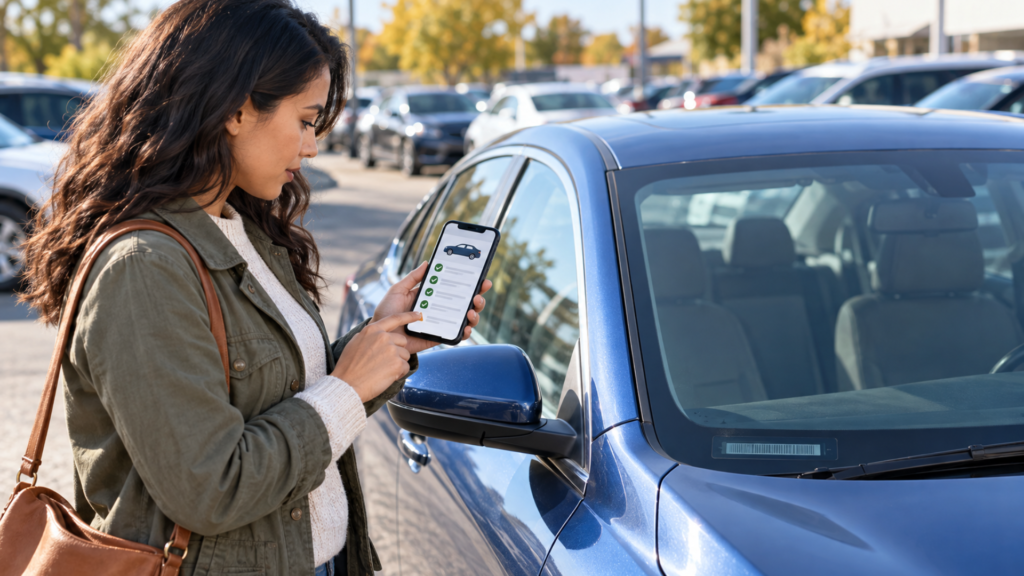
Learning how to check a used car’s history can reveal important information before you decide whether a vehicle deserves a closer inspection. Using the vehicle identification number, or VIN, you can research title records, reported odometer readings, salvage history, theft information, and open safety recalls.
However, no single database contains every repair, accident, or mechanical problem. A vehicle history report should be treated as one part of the research process—not as proof that a car is problem-free.
1. Check a Used Car’s History by Verifying the VIN
For most vehicles manufactured from the 1981 model year onward, the VIN is a unique 17-character identifier. It can usually be found on the driver’s side of the dashboard near the windshield, on the driver-side door label, and in registration or insurance documents.
Compare the VIN in each location with the number shown in the advertisement, title, registration, and vehicle history report. Numbers that do not match, damaged VIN plates, or labels that appear altered require further investigation.
Enter the VIN carefully when searching online. A single incorrect character can produce information for a different vehicle or prevent the search from returning useful results.
2. Obtain an NMVTIS Vehicle History Report
The National Motor Vehicle Title Information System, known as NMVTIS, provides access to information supplied by state motor vehicle agencies, insurance carriers, salvage yards, recyclers, and other participating organizations.
Consumers can visit the official NMVTIS vehicle history website to find approved report providers. Depending on the available records, a report may include title information, the most recently reported odometer reading, title-brand history, and certain theft or total-loss information.
NMVTIS does not sell reports directly. Consumers select an approved provider, and a fee may apply. Review the information and price offered by the provider before purchasing a report.
3. Review the Title and Brand History
If a record shows a salvage or rebuilt designation, review what a salvage title means and verify the requirements with the relevant state agency.
A title brand is a designation placed on a vehicle record by a state motor vehicle agency. Terminology varies by state, but examples may include salvage, junk, rebuilt, flood, or lemon-related brands.
A branded title does not automatically explain the vehicle’s current condition. It does indicate that you should investigate what happened, how the vehicle was repaired, whether required inspections were completed, and how the brand could affect registration, insurance, financing, resale value, or warranty coverage.
Ask the seller for copies of repair invoices, inspection documents, and title records. Confirm important information with the appropriate state motor vehicle agency.
4. Look for Odometer Inconsistencies
Compare the mileage displayed on the dashboard with the mileage listed in the history report, title documents, maintenance records, and inspection receipts.
Mileage should generally increase over time. A later record showing substantially fewer miles than an earlier one may indicate a reporting error, an instrument-cluster replacement, or possible odometer tampering.
Also compare the reported mileage with the vehicle’s visible condition. Excessive wear on the steering wheel, pedals, seats, and controls may justify additional questions, although wear alone cannot prove that the mileage is incorrect.
5. Check for Open Safety Recalls
A general history report may not provide complete or current recall information. Use the free NHTSA recall lookup tool and enter the VIN to check for unrepaired safety recalls associated with the vehicle.
NHTSA explains that its results may not display recalls that have already been repaired, some recently announced recalls, certain older recalls, or manufacturer service campaigns that are not safety recalls. Contact the manufacturer if the results require clarification.
If an open recall appears, ask an authorized dealership about the remedy and whether the repair is currently available.
6. Compare More Than One Information Source
Different databases may receive information from different organizations. One report might show title and salvage records, while another may contain reported service visits, auction announcements, accident information, or ownership changes.
Compare each report with the seller’s description, title documents, service records, and information available from the state motor vehicle agency. Missing information does not prove that an accident, repair, or ownership problem never occurred.
7. Ask the Seller Specific Questions
Use the report to guide a direct conversation with the seller. Ask about accidents, flood exposure, structural repairs, airbag deployment, title brands, dashboard warning lights, major mechanical work, and the reason for selling the vehicle.
Request important explanations and promises in writing. When buying from a dealer, review the Federal Trade Commission’s Buyers Guide carefully. The FTC provides information about reports, warranties, inspections, and dealer sales in its guide to buying a used car from a dealer.
8. Arrange an Independent Inspection
A clean report cannot confirm the current condition of the engine, transmission, brakes, tires, suspension, electrical system, or previous repairs. The FTC advises that a vehicle history report is not a substitute for an independent inspection.
Before making a final decision, ask a qualified independent mechanic to examine the vehicle. You can also follow our complete used-car inspection guide to identify areas that deserve attention before the professional evaluation.
Maintenance records can provide additional context about a vehicle’s history. Our article on essential car maintenance checks explains common vehicle-care items that buyers may want to review.
Warning Signs That Deserve More Research
- The VIN does not match across the vehicle and its documents.
- The seller refuses to provide the VIN before a meeting.
- Mileage records move backward or contain unexplained gaps.
- The title contains an unfamiliar brand or comes from another state.
- The seller’s explanation conflicts with the available records.
- Recent ownership changes appear without a reasonable explanation.
- The seller discourages an independent mechanical inspection.
Example: Resolve an Odometer Inconsistency
Suppose a service record lists 50,000 miles but a later listing shows 42,000 miles. That is a reason to pause, not enough evidence by itself to accuse the seller of fraud. Check that both records describe the same VIN and use miles rather than kilometers. Ask for original dated invoices and an explanation of any instrument-cluster replacement or data-entry error.
If the discrepancy remains unexplained, do not treat a clean-looking summary as proof of correct mileage. Ask your state’s motor vehicle agency about title and odometer records, and have an independent mechanic assess whether the vehicle’s condition is consistent with the available evidence. Records research and a physical inspection answer different questions.
Final Thoughts
Understanding how to check a used car’s history can help you identify questions that are easy to miss during a visual inspection. Start with the VIN, obtain information from reliable sources, check for open recalls, compare the report with the documents, and request clarification when the records do not agree.
The strongest buying decision combines documented history with a careful test drive and an independent professional inspection.
Related Automotive Guides
Continue exploring practical automotive resources before making a used-car purchase.
How to Inspect a Used Car Before Buying
Learn how to check the exterior, interior, mechanical condition, documents and warning signs.
10 Essential Car Maintenance Checks
Discover important maintenance items that can affect safety, reliability and vehicle condition.
Car Buying Guides
Explore more educational resources about buying used vehicles, ownership costs and purchase decisions.
Informational notice: This article provides general educational information and does not guarantee the condition, ownership history, safety, or legal status of any vehicle. Records may be incomplete or delayed. Verify important information with the appropriate government agency, report provider, seller, insurer, and a qualified automotive professional before making a decision.