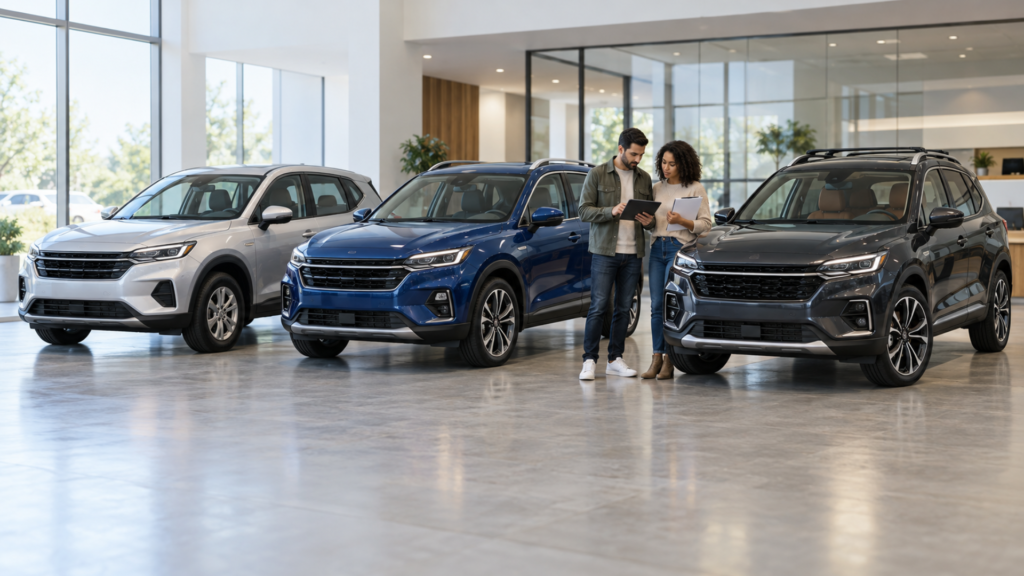
Learning how to compare vehicle trim levels can prevent confusion when two cars share the same model name but have different prices, equipment, engines, and safety features. The least expensive version may include everything you need, while a higher trim may add comfort or appearance features that provide little practical value for your driving.
Trim names are created by manufacturers and are not standardized across the automotive industry. A label such as Sport, Limited, Touring, Premium, or Platinum can mean something different depending on the brand, model, and year.
1. What Is a Vehicle Trim Level?
A trim level is a version of a vehicle model with a specific combination of equipment and styling. Manufacturers use trims to offer the same basic vehicle at several price and feature levels.
A base trim normally includes the standard equipment for the model. Mid-level trims may add convenience and technology, while upper trims can include larger wheels, upgraded interiors, additional driver-assistance systems, or more powerful engines.
The most expensive trim is not automatically the best choice for every buyer.
2. Compare Vehicle Trim Levels by Starting With Your Needs
Before studying trim names, make a short list of the features you genuinely need. Consider your driving environment, passengers, climate, parking conditions, cargo requirements, and typical trip distance.
Useful priorities might include:
- All-wheel drive for specific road or weather conditions.
- Additional airbags or driver-assistance technology.
- Easy-to-clean upholstery.
- Heated seats for cold climates.
- Parking sensors or a surround-view camera.
- Towing equipment.
- More passenger or cargo space.
Separate essential features from those that are simply attractive. This makes it easier to identify the lowest trim that meets your requirements.
3. Do Not Rely Only on the Trim Name
Manufacturers frequently change trim names and equipment between model years. A feature that was standard one year may become optional the next year, or it may move to a different package.
Two vehicles with the same trim name but different model years may therefore have different engines, screens, safety systems, wheels, or interior materials.
Always review the equipment list for the exact model year and vehicle instead of relying on advertisements or general descriptions.
4. Compare Standard Features Before Packages
Begin with the equipment included in each trim before examining optional packages. Create a simple comparison using only the features that affect your decision.
For example, if the mid-level trim already includes the safety technology, seating, and connectivity you need, moving to the highest trim may only add cosmetic details or features you rarely use.
Some options are available individually, while others require purchasing a package containing several unrelated items. Check the complete package description and price.
5. Check the Engine, Transmission, and Drivetrain
Compare AWD, 4WD, and FWD before paying for a drivetrain that may add little value to your routine.
A trim change may involve more than interior equipment. Some versions use a different engine, transmission, suspension, braking system, or drivetrain.
Higher performance can also affect fuel consumption, tire prices, insurance, and maintenance requirements. Larger wheels may improve appearance but can use more expensive tires and provide a firmer ride.
Compare mechanical specifications separately from appearance features so you understand what creates the price difference.
6. Study the Safety Equipment Carefully
Use our guide to U.S. car safety ratings to verify the tested model year and version rather than assuming a trim badge guarantees the same results.
Do not assume every trim includes the same driver-assistance systems. Automatic emergency braking, blind-spot monitoring, parking sensors, lane assistance, and adaptive cruise control may be standard, optional, or unavailable depending on the vehicle.
Confirm whether the feature is included in the exact trim or requires an additional package. Similar feature names may also describe systems with different capabilities.
Driver-assistance technology supports the driver but does not replace attention, safe driving, or understanding the owner’s manual.
7. Review the Window Sticker
For a new vehicle, the window sticker identifies the exact trim, standard equipment, factory-installed options, destination charge, and total manufacturer’s suggested retail price.
Compare the sticker with the dealer’s online listing and written quote. This can reveal whether an advertised feature belongs to the vehicle or is only available on another trim.
Our guide on how to read a new car window sticker explains each major section.
8. Compare the Total Price, Not Only the Monthly Payment
A higher trim may appear affordable when the discussion focuses only on the monthly payment. However, a longer loan term or different interest rate can hide the full difference in cost.
Compare the vehicle price, taxes, government fees, dealer charges, optional products, interest, and total amount paid. The Federal Trade Commission recommends requesting the out-the-door price in writing before visiting a dealership.
Compare equivalent quotes and keep financing discussions separate from the value of your trade-in whenever possible.
9. Consider Ownership Costs
The purchase price is only one part of the decision. Different trims can have different long-term expenses.
Before selecting a version, investigate:
- Insurance premiums.
- Tire size and replacement cost.
- Fuel or electricity consumption.
- Maintenance requirements.
- Repair cost for lights, cameras, sensors, and wheels.
- Warranty coverage.
A feature that adds value for one driver may create unnecessary expense for another.
10. Check Used Vehicles Individually
When comparing used vehicles, verify that the advertised trim is correct. Exterior badges can be removed, replaced, or added, and online listings may contain mistakes.
Review the VIN information, original window sticker when available, equipment, service records, and manufacturer specifications. NHTSA provides a free VIN decoder, although available details can vary.
Vehicle condition and maintenance history are usually more important than choosing a higher trim with neglected service.
Quick Trim-Level Comparison Checklist
- Identify the features you actually need.
- Compare the same model year and drivetrain.
- Separate standard equipment from optional packages.
- Verify safety technology on the exact vehicle.
- Review the window sticker or original equipment list.
- Compare written out-the-door prices.
- Estimate insurance, tires, fuel, and maintenance.
- Test-drive the trims you are seriously considering.
A Worked Trim Comparison
This invented example shows the method, not actual vehicle prices or equipment. Assume the same model year, engine, drivetrain, destination charge, and no dealer add-ons.
| Trim | Illustrative price before tax and fees | What changes | Decision |
|---|---|---|---|
| Base | $28,000 | Required safety equipment and smartphone connectivity | Meets the core needs |
| Mid | $30,000 | Adds heated seats and adjustable lumbar support | $2,000 premium for features used regularly |
| Top | $34,000 | Adds larger wheels, premium audio, and a panoramic roof | $4,000 more than Mid for mostly optional preferences |
If lumbar support is a must-have, compare Mid with the exact package needed on Base. If it is unavailable on Base, the cheapest trim fails that requirement. If it is available for $800, compare that configured Base at $28,800 against Mid—not the unconfigured $28,000 starting price.
Over five years, the $2,000 Base-to-Mid premium alone is $33.33 per month before financing, resale differences, insurance, or maintenance. This is a price comparison, not a loan payment. Verify the actual vehicle window sticker and use the ownership cost calculator for the broader budget.
Final Thoughts
The best way to compare vehicle trim levels is to focus on useful features, mechanical differences, safety equipment, and total ownership cost—not the prestige of a trim name.
Choose the version that meets your realistic needs without paying for equipment you are unlikely to use. A well-equipped mid-level trim may sometimes offer a better balance than either the base or most expensive version.
This article provides general educational information and is not financial or purchasing advice. Trim names, equipment, prices, warranties, and specifications vary by manufacturer, model year, vehicle, and market. Verify all details before making a purchase.