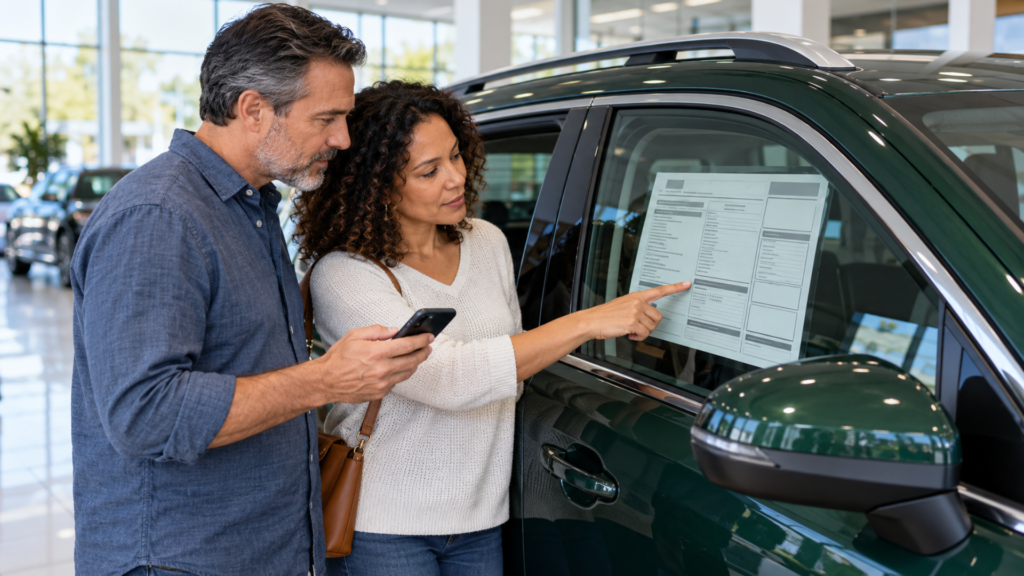
A new car window sticker contains much more than the vehicle’s suggested price. It can help shoppers verify the exact model, factory-installed equipment, destination charge, fuel economy estimates, and available government safety-rating information.
In the United States, this federally required label is commonly called the Monroney label. Learning how to read it can make vehicle comparisons clearer and help identify the difference between manufacturer information and additional dealer charges.
An Annotated Window-Sticker Example
This simplified teaching example is not an actual manufacturer label or a dealer quote. Label placement varies.
| Label section | Illustrative entry | What to check |
|---|---|---|
| 1. Vehicle identity | Model year, trim, engine, drivetrain and VIN | Matches the actual vehicle and listing |
| 2. Base MSRP | $28,000 | Standard equipment included |
| 3. Factory options | $1,500 | Individual items and package contents |
| 4. Destination | $1,400 | Not counted twice in the dealer quote |
| 5. Total MSRP | $30,900 | $28,000 + $1,500 + $1,400; not the out-the-door price |
| 6. Energy label | MPG or MPGe, consumption and relevant estimates | Exact powertrain and test assumptions |
| 7. Safety results | Available government test results | Not tested is different from failing |
1. What Is a New Car Window Sticker?
The Monroney label is attached to a new vehicle before it is offered for sale. It provides standardized information about that specific vehicle rather than a general description of every model with the same name.
The label typically identifies the manufacturer, model, trim, engine, transmission, standard equipment, factory-installed options, manufacturer’s suggested retail price, and transportation charge.
Because equipment can vary between vehicles that appear nearly identical, shoppers should read the label for the exact vehicle they are considering.
2. Verify the Model, Trim, and Vehicle Details
Begin with the identification section. Confirm the model year, model name, trim level, exterior color, interior color, powertrain, and drivetrain.
You may also find the Vehicle Identification Number, or VIN. Compare it with the VIN displayed on the dashboard or vehicle paperwork to make sure the sticker belongs to that specific car.
Small differences in trim or equipment can affect price, performance, fuel economy, and available safety features.
3. Understand the Base Price
The base price represents the manufacturer’s suggested retail price for the vehicle with its standard equipment and factory warranty, before additional factory options and transportation charges are added.
Standard equipment may include items such as airbags, climate control, infotainment features, wheels, driver-assistance technology, or interior materials. The included features depend on the manufacturer and trim level.
Remember that MSRP means manufacturer’s suggested retail price. It is not necessarily the final amount a buyer will pay.
4. Review Factory-Installed Options
The options section lists equipment added by the manufacturer beyond the standard configuration. These items may be installed individually or grouped into packages.
Examples can include upgraded wheels, premium audio, special paint, additional driver-assistance systems, towing equipment, heated seats, or appearance packages.
Read each line carefully. A package with a broad name may contain several separate features. Confirm that the equipment is useful to you instead of assuming every option is necessary.
5. Locate the Destination Charge
The destination or transportation charge covers delivery of the vehicle from the manufacturer to the dealership. It is normally listed separately near the pricing section.
When comparing vehicles, check whether a quoted price already includes this charge. This can prevent confusion if the same transportation amount appears again during price discussions or paperwork.
Destination charges can vary among manufacturers and vehicle models.
6. Read the Total Suggested Retail Price
The total MSRP generally combines the base price, factory-installed options, and destination charge shown on the label. It provides a consistent starting point for comparing similarly equipped vehicles.
However, the total MSRP is not the same as the final out-the-door price. Sales tax, registration, title charges, government fees, dealer-installed products, documentation charges, discounts, and negotiated adjustments may affect the final amount.
The Federal Trade Commission recommends requesting the out-the-door price in writing before visiting the dealership.
7. Examine the Fuel Economy and Environment Label
A new car window sticker includes fuel economy information based on standardized testing overseen by the Environmental Protection Agency.
For gasoline vehicles, the label normally displays estimated city, highway, and combined miles per gallon. It may also show estimated annual fuel cost, fuel consumption, emissions ratings, and a comparison with other vehicles.
Electric-vehicle labels use miles per gallon equivalent, or MPGe, and may include estimated driving range, charging time, and electricity consumption.
These figures provide a common comparison method, but actual results can vary with weather, traffic, driving habits, vehicle load, maintenance, and accessory use. The EPA offers detailed explanations through its fuel economy label guide.
8. Check the Government Safety Ratings
When testing has been completed and results are available, the label may display NHTSA’s government safety ratings. The system uses one to five stars, with five representing the highest rating.
Separate results may be provided for frontal crashes, side crashes, and rollover resistance. Ratings should be compared carefully because vehicle size and weight can affect how certain results are interpreted.
You can learn more in our guide explaining how car safety ratings work in the United States or search the official NHTSA ratings database.
9. Identify Supplemental Dealer Stickers
Our dealer-fee guide helps separate factory pricing, government charges, and optional dealer products when reviewing a written out-the-door quote.
A dealership may place an additional label beside the manufacturer’s window sticker. This supplemental sticker can list dealer-installed accessories, protection products, preparation charges, or market adjustments.
These additions are different from factory-installed options on the Monroney label. Examine each item and ask whether it is optional, removable, or already included elsewhere.
Do not assume that an extra product is required simply because it has already been installed or printed on another sticker.
10. Use the Sticker as a Comparison Tool
- Confirm the exact VIN, model year, trim, and drivetrain.
- Compare standard equipment and factory options.
- Review the destination charge.
- Check the total MSRP against the quoted price.
- Compare fuel economy or electric driving information.
- Review available government safety ratings.
- Separate manufacturer charges from dealer additions.
- Request a written out-the-door price before agreeing to buy.
Final Thoughts
A new car window sticker gives shoppers a standardized summary of the vehicle’s equipment, suggested price, efficiency, and available safety information. It is one of the most useful documents for comparing new vehicles before discussing financing or optional products.
Review the label slowly, confirm that it matches the exact vehicle, and keep a copy for your records. The information can help you ask better questions and understand how the final price was calculated.
This article provides general educational information and does not offer legal, financial, or purchasing advice. Vehicle labels, fees, taxes, equipment, and dealership practices can vary by vehicle, state, manufacturer, and seller. Verify all information before signing a purchase agreement.