
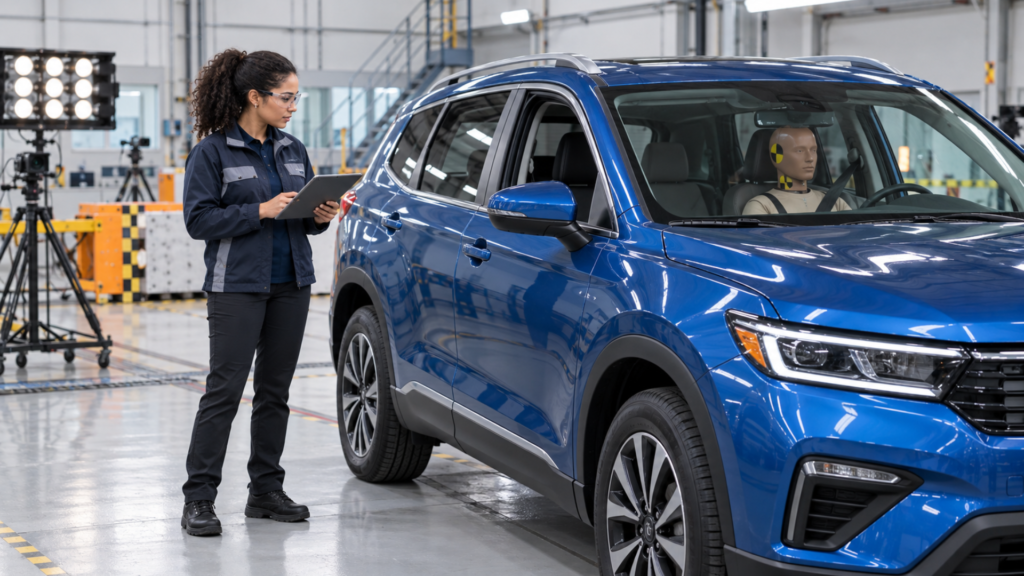
Car safety ratings can help drivers compare vehicles, but the numbers and awards are not always easy to understand. In the United States, two major organizations evaluate vehicle safety: the National Highway Traffic Safety Administration, commonly known as NHTSA, and the Insurance Institute for Highway Safety, or IIHS.
Although both organizations study vehicle safety, they use different tests, scoring methods, and evaluation criteria. Understanding those differences can help you interpret the results more accurately before choosing a vehicle.
1. What Car Safety Ratings Measure
Safety evaluations examine how well a vehicle may protect occupants during certain types of crashes. They may also consider technology designed to prevent or reduce the severity of a collision.
Depending on the organization and model year, evaluations may include frontal crashes, side impacts, rollover risk, headlights, pedestrian detection, and automatic emergency braking.
However, no laboratory test can reproduce every possible real-world collision. Ratings should be treated as an important comparison tool—not as a guarantee that occupants will never be injured.
2. How NHTSA’s 5-Star Safety Ratings Work
NHTSA is a United States government agency. Its 5-Star Safety Ratings program evaluates vehicles using a scale from one to five stars. Five stars represent the highest rating within the system.
NHTSA examines areas such as frontal crash protection, side crash protection, and rollover resistance. The agency may also publish an overall vehicle score based on its evaluations.
When comparing results, look at vehicles of a similar type and weight. A five-star rating does not necessarily mean that a small vehicle will provide the same protection as a much heavier vehicle during every type of collision.
NHTSA also explains that a vehicle can receive a high star rating while still having a separate safety concern. For that reason, shoppers should review the complete result rather than relying only on the overall number of stars.
3. How IIHS Vehicle Ratings Work
IIHS is an independent nonprofit organization supported by automobile insurers and insurance associations. Its vehicle ratings examine crashworthiness as well as crash-avoidance and mitigation technology.
Instead of using only a five-star scale, IIHS publishes results for individual evaluations. Depending on the test, the organization may use classifications such as Good, Acceptable, Marginal, or Poor.
IIHS also awards Top Safety Pick and Top Safety Pick+ designations to qualifying vehicles. The requirements can change as testing methods and safety technology evolve, so an award from one year should not automatically be compared with an award from another year.
4. Why NHTSA and IIHS Results May Differ
NHTSA and IIHS may give different results to the same vehicle because their tests are not identical. They may use different crash configurations, speeds, barriers, measurements, or scoring methods.
A difference between the two results does not necessarily mean that one organization is incorrect. Each system provides a different perspective on vehicle performance.
For a more complete picture, review both sets of results when they are available. Looking beyond the headline score can reveal strengths or weaknesses in particular areas.
5. Verify the Exact Model Year and Vehicle Version
Car safety ratings may vary between model years, even when two vehicles look almost identical. Manufacturers sometimes change the structure, airbags, headlights, driver-assistance systems, or other components during a vehicle’s production cycle.
Body style and equipment can also matter. A sedan, hatchback, and sport utility vehicle with similar names may not share the same rating. Some safety technology may be standard on one trim but optional or unavailable on another.
Before relying on a result, confirm the exact model year, body style, drivetrain, and equipment described on the rating page.
6. Ratings Are Only Part of the Safety Picture
A strong rating is valuable, but the condition of the vehicle remains important. Damaged tires, worn brakes, defective lights, unresolved recalls, and neglected maintenance can affect safety regardless of the original test result.
Used-car shoppers should also investigate whether a vehicle has experienced major collision damage or improper repairs. Structural damage may affect how the vehicle performs in another crash.
You can combine safety-rating research with our guides on how to inspect a used car and essential car maintenance checks.
7. Check for Open Safety Recalls
Safety ratings and recalls provide different information. A rating describes performance in specific evaluations, while a recall addresses a safety-related defect identified in certain vehicles or equipment.
Before buying a used vehicle, enter its Vehicle Identification Number in the official NHTSA recall lookup tool. The search can show whether the vehicle has an unrepaired safety recall.
Recall repairs are generally handled through an authorized manufacturer dealership. Contact the manufacturer or dealer to confirm eligibility and arrange the appropriate service.
8. How to Use Car Safety Ratings When Shopping
- Search for the exact model year and body style.
- Review both NHTSA and IIHS results when available.
- Read the individual test results, not only the overall score.
- Check whether important safety features are standard or optional.
- Compare vehicles of a similar category and size.
- Investigate open recalls using the vehicle’s VIN.
- Have a used vehicle inspected before completing the purchase.
Final Thoughts
Car safety ratings make it easier to compare how vehicles perform under controlled testing conditions. NHTSA’s star system and IIHS evaluations offer complementary information, but neither system should be considered an absolute prediction of what will happen in every collision.
Use the ratings together with recall information, vehicle history, maintenance condition, safety equipment, and a professional inspection. A careful review of all these factors can support a more informed vehicle decision.
This article provides general educational information. Test methods, award requirements, vehicle equipment, and ratings may change. Verify current information with NHTSA, IIHS, the vehicle manufacturer, and a qualified automotive professional.