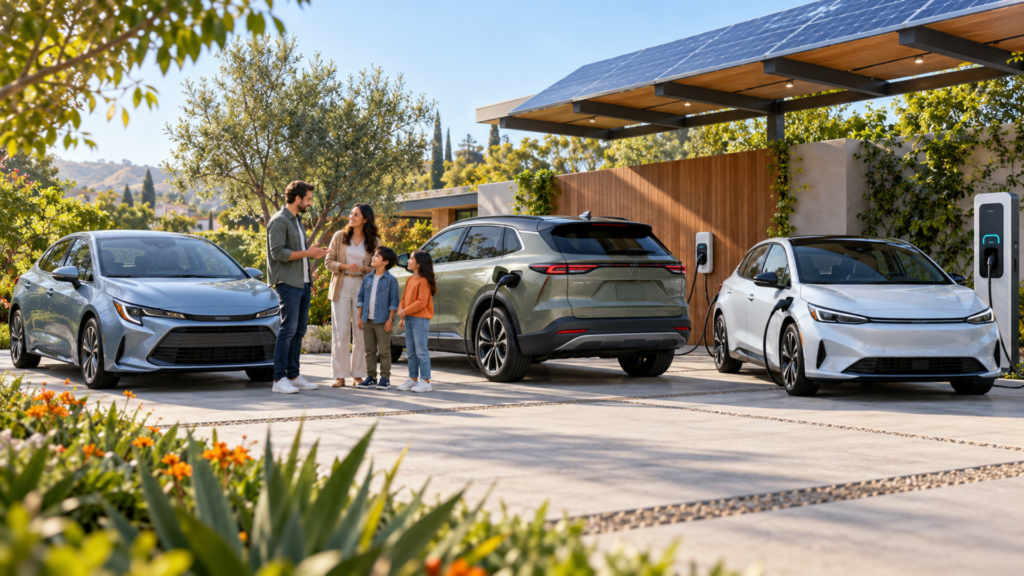
When choosing between a hybrid, a plug-in hybrid, and an electric car, consider how each uses energy, whether you can charge at home, and the ownership costs that fit your driving routine.
The most suitable option depends on your daily mileage, access to charging, climate, travel patterns, budget, and how long you expect to keep the vehicle.
Hybrid vs Plug-In Hybrid vs Electric Car: Quick Comparison
- Hybrid electric vehicle: combines an internal combustion engine with an electric motor but cannot be plugged into an external charger.
- Plug-in hybrid electric vehicle: combines an engine with a larger battery that can be charged from an external electricity source.
- Battery-electric vehicle: uses one or more electric motors and operates without a gasoline engine.
All three may use regenerative braking to recover some energy during deceleration, but their batteries, electric-driving capability, and fueling requirements are different.
How a Conventional Hybrid Works
A hybrid electric vehicle, commonly called an HEV or simply a hybrid, uses gasoline and electricity. Its battery is charged by the internal combustion engine and regenerative braking, so the driver does not connect it to a charging station.
The electric motor can assist the engine during acceleration, reduce engine operation while stopped, and sometimes move a full hybrid for short distances at low speeds.
Potential hybrid advantages
- No external charging is required.
- Fuel economy can be better than a similar non-hybrid vehicle.
- Refueling works like it does with a conventional gasoline vehicle.
- It may suit drivers without reliable access to home charging.
Potential hybrid limitations
- It still depends on gasoline.
- Electric-only operation is generally limited.
- It contains both combustion and electrical components.
- Purchase prices may be higher than comparable non-hybrid models.
How a Plug-In Hybrid Works
A plug-in hybrid electric vehicle, or PHEV, also contains an engine and electric motor, but it has a larger battery that can be charged from an electrical outlet or charging station.
Many PHEVs can complete shorter trips using mainly or entirely electric power. When the battery reaches a low state of charge, the vehicle can continue operating using its engine and hybrid system.
Potential PHEV advantages
- Electric driving may cover part or all of a daily commute.
- The engine provides flexibility for longer journeys.
- Drivers are not completely dependent on public charging.
- Regular charging can reduce gasoline consumption.
Potential PHEV limitations
- The vehicle carries both an engine and a larger battery.
- It may cost more than a conventional hybrid.
- Fuel savings depend heavily on regular charging.
- Cargo or passenger space may be affected by battery placement.
The U.S. Department of Energy explains that a PHEV that is rarely plugged in may operate much like a similarly sized conventional hybrid. Consistent charging is therefore important for receiving its full electric-driving benefit.
How a Battery-Electric Vehicle Works
A battery-electric vehicle, also known as a BEV or EV, uses electricity stored in a battery pack to power one or more electric motors. It has no gasoline engine and produces no direct tailpipe emissions.
The battery must be replenished using external charging equipment. Charging may take place at home, at work, or at a public charging station, depending on the driver’s access and the vehicle’s compatibility.
Potential EV advantages
- No gasoline purchases or combustion-engine oil changes.
- Fewer moving powertrain components.
- Quiet operation and immediate electric-motor response.
- No direct exhaust or tailpipe emissions.
- Home charging can be convenient for many drivers.
Potential EV limitations
- Charging takes longer than filling a fuel tank.
- Public charging availability varies by location.
- Range may decrease in extreme temperatures.
- Long trips may require charging planning.
- Battery replacement outside warranty can be expensive.
Charging Requirements
A conventional hybrid does not require external charging. PHEVs and EVs can generally use Level 1 or Level 2 charging, although charging speeds depend on the vehicle and equipment.
DC fast charging is designed for compatible vehicles during longer journeys or situations requiring a quicker charge. Not every PHEV accepts DC fast charging, and EV charging speeds can differ substantially.
Before buying a plug-in vehicle, determine:
- Whether charging is permitted where you park.
- What electrical equipment is already available.
- How much installation might cost.
- Which connector the vehicle uses.
- Whether compatible public stations exist along regular routes.
- How quickly the specific model can accept electricity.
Range and Long-Distance Travel
Hybrid vehicles rely on gasoline and can be refueled quickly. PHEVs provide an electric range for shorter trips and continue with their engine after the usable battery charge is reduced.
An EV depends entirely on its battery and charging access. Its official range is an estimate rather than a guarantee. Speed, weather, hills, cargo, towing, heating, air conditioning, and driving style can change actual energy consumption.
Drivers who frequently travel through areas with limited charging should examine station locations and charging reliability before choosing a fully electric vehicle.
Maintenance Differences
Hybrids and PHEVs retain an internal combustion engine, so they still require services such as oil changes, filters, fluids, and inspections according to the manufacturer’s schedule.
EVs generally require less powertrain maintenance because they have fewer moving parts and no engine oil. Regenerative braking may also reduce wear on conventional brake components.
However, electric vehicles still need tire inspections and rotation where permitted by the manufacturer, brake inspections, suspension service, cabin filters, cooling-system checks when applicable, and maintenance of the low-voltage electrical system.
Review our essential car maintenance guide for routine items that remain important across different powertrains.
Comparing Energy and Ownership Costs
Request insurance quotes for each candidate as well as energy estimates; our guide to vehicle factors that affect insurance costs explains why similar purchase prices can produce different premiums.
Do not compare vehicles using fuel economy alone. Consider the purchase price, gasoline rates, electricity rates, insurance, battery warranty, maintenance, charging installation, tire replacement, and expected resale value.
For a PHEV, estimate how many miles would realistically be driven on electricity. For an EV, calculate charging costs using your local electricity rate rather than assuming charging will always be free.
The official FuelEconomy.gov website provides efficiency, energy-use, range, and estimated annual fuel-cost information for individual models.
Which Option May Fit You?
A hybrid may fit if:
- You cannot charge at home or work.
- You want improved fuel economy without changing refueling habits.
- You regularly take long trips through areas with limited chargers.
A plug-in hybrid may fit if:
- You can charge regularly.
- Most daily trips fall within the vehicle’s electric range.
- You still want an engine for longer travel.
An electric vehicle may fit if:
- You have dependable home or workplace charging.
- The vehicle’s practical range covers your normal driving.
- You are comfortable planning charging during longer trips.
- You prefer a vehicle without a gasoline engine.
Charging and Maintenance Comparison
| Question | HEV | PHEV | BEV |
|---|---|---|---|
| Plug in? | No | Yes, regularly to benefit from electric miles | Yes, required |
| Combustion engine? | Yes | Yes | No |
| Engine oil service? | Per manufacturer schedule | Per manufacturer schedule, even with low gasoline use | No engine oil; other service remains |
| Long-trip planning | Fuel stops | Fuel stops plus optional compatible charging | Compatible charging stops and weather-adjusted range |
For cost comparisons, use the two-vehicle ownership calculator with realistic monthly energy expenses. For a PHEV, include both electricity and gasoline. Include charging installation separately in your total budget and do not assume the calculator quotes installation or charging tariffs.
Final Thoughts
In the hybrid vs plug-in hybrid vs electric car comparison, no single powertrain is ideal for every driver. A hybrid offers familiar fueling, a PHEV combines electric commuting with an engine, and an EV eliminates gasoline use but depends completely on charging.
Compare specific models, warranties, official efficiency information, charging capability, and real driving needs before making a decision.
This article provides general educational information and does not recommend a particular vehicle or powertrain. Range, charging speed, fuel economy, maintenance, battery coverage, and ownership costs vary by model, climate, electricity source, driving conditions, and location. Verify current specifications with official sources and the vehicle manufacturer.