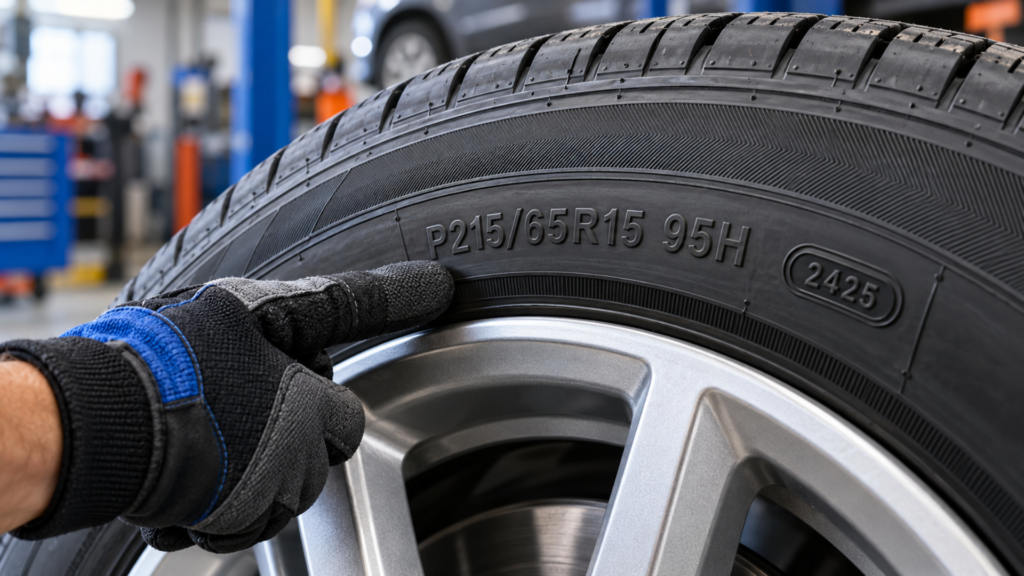
Learning how to read a tire sidewall can help you choose an appropriate replacement, check a tire’s manufacturing date, and understand important limits related to load, speed, and inflation.
The collection of letters and numbers may initially appear confusing, but each section provides specific information. This guide uses P215/65R15 95H as a practical example.
How to Read a Tire Sidewall Size
The size code is usually one of the most visible markings on a passenger-vehicle tire. In the example P215/65R15 95H, each component has a different meaning.
P: Tire Type
The letter P indicates a tire intended for passenger-vehicle use under the P-metric sizing system. This can include many cars, minivans, crossovers, and SUVs.
Other tires may begin with LT, meaning light truck, or T, commonly used for a temporary spare. Some metric tire sizes begin directly with the width and do not include a letter before the number.
215: Tire Width
The number 215 represents the tire’s nominal section width in millimeters, measured from one sidewall to the other.
A larger number generally indicates a wider tire, but width alone does not determine whether a tire fits a particular vehicle. Wheel dimensions, suspension clearance, load requirements, and manufacturer specifications must also be considered.
65: Aspect Ratio
The number after the slash is the aspect ratio. In this example, the sidewall height is approximately 65 percent of the tire’s width.
This number is a percentage, not a direct measurement in millimeters. A lower aspect ratio usually produces a shorter sidewall relative to the tire’s width, while a higher ratio indicates a taller sidewall.
R: Tire Construction
The letter R means the tire uses radial construction. Radial tires are the standard design found on most modern passenger vehicles.
A temporary spare may sometimes display a different construction letter. Replacement tires should follow the size and construction specifications approved by the vehicle manufacturer.
15: Wheel Diameter
The number 15 indicates that the tire is designed for a wheel with a 15-inch diameter.
This measurement must match the wheel. A tire designed for a 15-inch wheel cannot be correctly installed on a 16-inch wheel, even when other parts of the size appear similar.
What Does the Load Index Mean?
In the example, 95 is the load index. It corresponds to the maximum weight that one properly inflated tire can support under specified test conditions.
The number is an index, not a weight in pounds. In Michelin’s load-index chart, 95 corresponds to 1,521 lb (690 kg) per tire under the applicable load and inflation conditions. This does not mean four such tires establish a vehicle payload allowance: vehicle and axle limits still apply.
Replacement tires should meet the load requirements established by the vehicle manufacturer. Choosing a lower load index can reduce the tire’s ability to support the vehicle, passengers, luggage, and other cargo safely.
Check the driver-side door label and owner’s manual before purchasing tires. For vehicles with different front and rear tire specifications, examine both positions separately.
What Does the Speed Rating Mean?
The final letter, H, is the speed rating. The same manufacturer chart lists H as 130 mph (210 km/h) under specified conditions. This classification is not a safe or legal road-speed recommendation, and it does not override the vehicle manufacturer’s requirements.
A speed rating is not a recommendation to drive at that speed. Road conditions, tire wear, inflation, temperature, vehicle condition, traffic laws, and vehicle load can all reduce safe operating limits.
Use a replacement tire with a speed rating that meets the vehicle manufacturer’s requirements. Mixing tires with different ratings may affect handling and performance, so consult a qualified tire professional when specifications differ.
How to Read the DOT Tire Date Code
A tire’s DOT Tire Identification Number, or TIN, begins with the letters DOT. The complete number identifies manufacturing information and helps determine whether a tire is included in a safety recall.
For tires manufactured since 2000, the final four digits show the production week and year. For example:
- 2425 means the tire was manufactured during the 24th week of 2025.
- 0824 means it was manufactured during the eighth week of 2024.
The complete TIN may appear on only one side of the tire. If the full date code faces inward and is not safely visible, ask a tire professional to read it. Do not crawl under a vehicle supported only by a jack or reach into an unsafe position to find it.
Age alone does not reveal the complete condition of a tire. Storage, sunlight, climate, inflation, road impacts, loading, and maintenance can affect deterioration. Cracks, bulges, vibration, repeated pressure loss, or other damage require professional inspection.
Maximum Pressure Is Not the Recommended Pressure
The sidewall also displays a maximum inflation pressure. This is not automatically the correct pressure for everyday driving.
The proper cold-tire pressure for the vehicle is listed on the Tire and Loading Information Label, generally located on the driver-side doorjamb, or in the owner’s manual. NHTSA specifically advises drivers to use the vehicle manufacturer’s recommended pressure rather than the maximum number printed on the tire.
Check pressure when the tires are cold, usually before driving or after the vehicle has remained parked for several hours.
Understanding Treadwear, Traction and Temperature Grades
Many passenger tires sold in the United States carry Uniform Tire Quality Grading information:
- Treadwear: provides a relative comparison of wear under controlled testing.
- Traction: evaluates straight-line braking performance on wet pavement and is graded from AA to C.
- Temperature: indicates resistance to heat generation and is graded A, B, or C.
These grades can help compare tires, but they do not predict exact mileage or performance in every condition. Driving style, maintenance, climate, vehicle alignment, and road surfaces also influence tire life.
Before Purchasing Replacement Tires
Our AWD, 4WD, and FWD comparison explains drivetrain differences; follow your vehicle manufacturer’s tire-matching requirements rather than assuming all systems tolerate the same replacements.
- Check the tire label on the driver-side doorjamb.
- Confirm the complete size, load index, and speed rating.
- Check whether the front and rear tires require different sizes.
- Read the DOT date code and inspect the tire’s physical condition.
- Never use the sidewall maximum pressure as the normal target pressure.
- Ask a qualified professional before changing wheel or tire dimensions.
The official NHTSA TireWise resource provides additional information about tire selection, labeling, maintenance, pressure, aging, and recalls.
You can also review our essential car maintenance checks for other routine items that drivers should monitor.
Tire Markings at a Glance
| Marking | Meaning | Unit or next step |
|---|---|---|
| P | Passenger tire under the P-metric system | Other systems use different prefixes |
| 215 | Nominal section width | Millimeters |
| 65 | Sidewall height relative to width | 65%, approximately 139.75 mm in this nominal example |
| R | Radial construction | Not a speed rating here |
| 15 | Wheel diameter | Inches; must match the wheel |
| 95 / H | Load index / speed rating | 95: 1,521 lb (690 kg) per tire; H: 130 mph (210 km/h) classification. Apply the stated conditions and vehicle requirements. |
| DOT ending 2425 | Manufacturing date | Week 24 of 2025, for a modern four-digit date code |
Age, Fit, and Safe Inspection
Changing width, aspect ratio, or wheel diameter changes more than appearance and may affect clearance and speedometer readings. Have a tire professional confirm an approved combination. Do not crawl under a vehicle supported only by a jack to find an inward-facing date code.
Some vehicle and tire manufacturers specify an age-based replacement limit even when tread remains. Follow their guidance; the date code alone cannot establish safety. Review NHTSA’s tire labeling and aging guidance and obtain the load/speed chart from the manufacturer of the exact tire.
Final Thoughts
Knowing how to read a tire sidewall makes the information molded into the rubber much more useful. The size code identifies important dimensions, the load and speed ratings describe operating limits, and the DOT number helps identify the tire and its manufacturing date.
Always compare these markings with the vehicle manufacturer’s specifications. A tire that physically fits a wheel is not necessarily appropriate for the vehicle’s load, handling, or safety requirements.
This article provides general educational information. Tire specifications, replacement requirements, and compatibility vary by vehicle. Consult the owner’s manual, the vehicle’s tire label, and a qualified tire professional before purchasing or installing replacement tires.