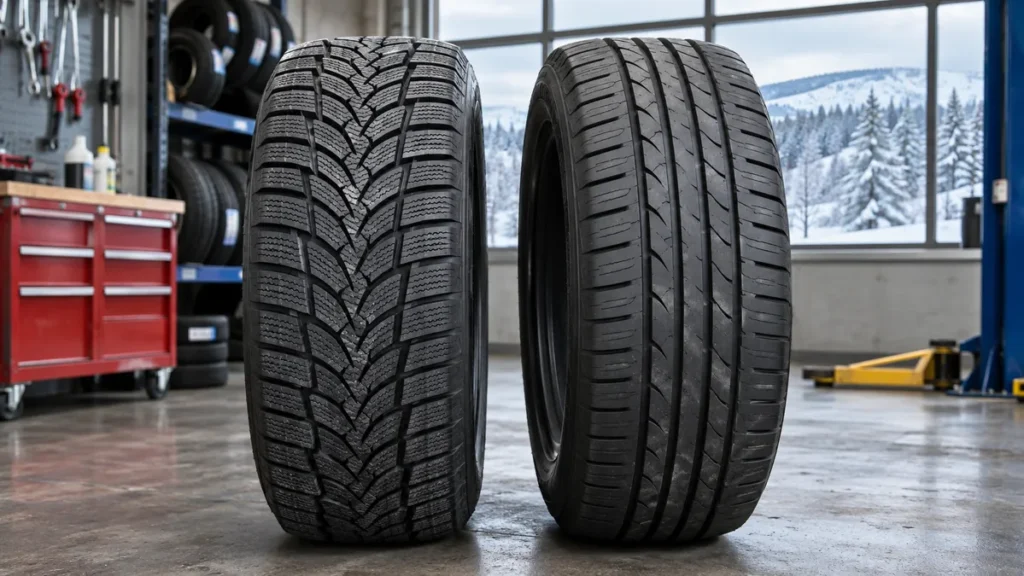
Choosing winter tires vs. all-season tires starts with the conditions you must drive through, not the badge on the back of your vehicle. A driver who can stay home during occasional snow has different needs from someone who commutes before roads are cleared. All-wheel drive does not remove the need to choose suitable tires.
Use this guide to prepare a conversation with a qualified tire professional. It explains the categories and the questions to ask without treating one tire type as the right answer for every U.S. climate.
Winter Tires vs. All-Season Tires: The Main Difference
Winter tires use tread designs and compounds intended for cold-weather traction. All-season tires balance several conditions and generally suit moderate climates, including light snow, but they are not equivalent to dedicated winter tires in severe winter conditions.
Summer tires are another category. Their performance focus does not make them suitable for snow or freezing conditions. If your vehicle came with performance tires, identify the actual product and its temperature limitations rather than assuming factory equipment is appropriate year-round.
Understand the Snowflake Symbol
The three-peak mountain snowflake symbol indicates that a tire meets a defined snow-traction performance requirement. It is different from an M+S marking. Some tires marketed as all-weather carry the snowflake symbol while being intended for year-round use. The symbol alone does not mean that every such tire performs identically on ice, wet roads, or packed snow.
For other markings, including size and load information, see our tire-sidewall guide. A seasonal label does not override the vehicle’s size, load, or compatibility requirements.
Describe Your Real Driving Conditions
Write down the routes you cannot avoid, how frequently they experience winter conditions, and whether you can postpone travel. Include elevation changes and trips outside your home area. Living in a mild city does not describe a regular journey over a snowy mountain pass.
Then ask a tire shop to explain the options for that pattern. Request the exact tire model, not just “winter” or “all-season.” Compare documented performance information and suitability for your vehicle. Avoid making a decision from an aggressive-looking tread alone.
Plan a Complete Compatible Set
Follow the vehicle and tire manufacturers’ guidance about matching tires. A common recommendation is to fit winter tires on all four wheels rather than only the driven axle. Mixed seasonal performance can create an undesirable balance of grip. Staggered sizes or other original vehicle arrangements require particular care.
Ask whether a separate wheel set is suitable and what it means for the tire-pressure monitoring system. Separate wheels may make seasonal changes more convenient, but they are not automatically required. Wheel clearance, dimensions, load capacity, and sensor compatibility all need verification.
Include Storage and Changeovers in the Decision
A seasonal setup involves more than buying tires. Decide where the unused set will be stored, who will inspect it, and when you will arrange changeovers. Ask the shop to explain proper storage for your wheel-and-tire arrangement. Labeling positions and retaining invoices can make future service more organized.
Keep a simple comparison sheet:
- Exact tire model and compatible size.
- Intended weather conditions and relevant markings.
- Wheel and sensor requirements.
- Changeover and storage arrangements.
- Inspection and replacement considerations.
This keeps practical ownership needs visible beside the initial purchase decision. If your plans include a move or new commute, reassess the conditions rather than automatically repeating the previous setup.
Grip Still Has Limits
Suitable tires are one part of winter preparation. They do not make a closed road safe or eliminate the need to slow down and allow more space. Review the role of your drivetrain in our AWD, 4WD, and FWD comparison, and keep tire condition and inflation under regular review.
The useful decision is the one you can explain in terms of your vehicle, route, and climate. If a recommendation is based only on a brand slogan, ask for the specific reason it fits your situation.
Sources and Further Reading
This is general educational information. Verify compatibility, seasonal limitations, and local requirements with your vehicle manual and a qualified tire professional.