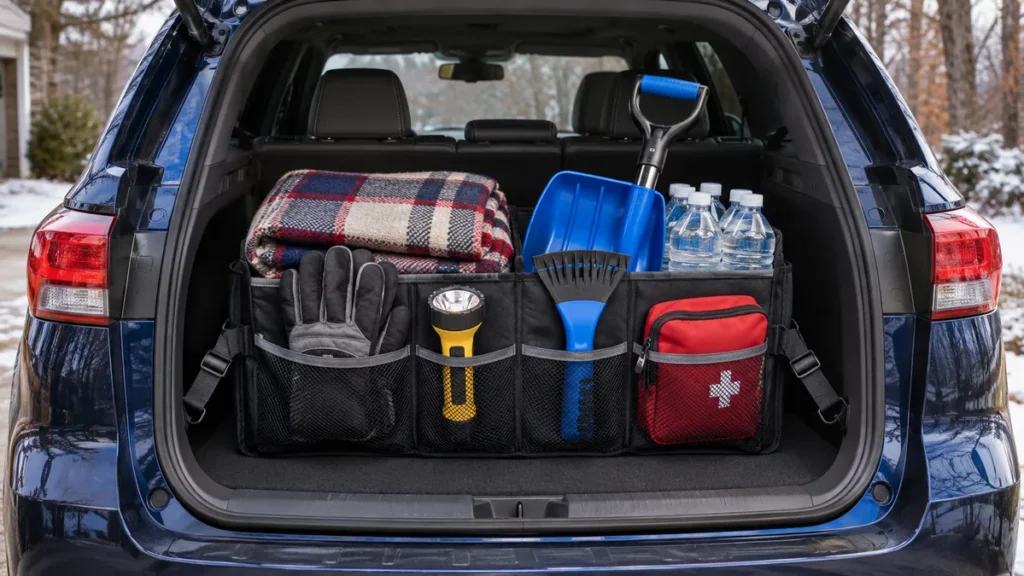
A winter car emergency kit is most useful when it matches the people in your vehicle and the route you actually drive. A short urban commute and a remote mountain trip do not create the same needs. Start with a practical question: if a delay lasted several hours, what would help everyone stay warm, communicate, and wait safely?
This guide focuses on organizing supplies before a trip. It does not replace checking road conditions, maintaining your vehicle, or postponing travel when conditions are unsafe.
Build Your Winter Car Emergency Kit Around Five Needs
1. Communication
Pack a compatible phone cable, a vehicle charger, and a charged portable power bank. Keep roadside-assistance details somewhere accessible without opening an app. Write down an emergency contact and your vehicle information on a small card. A phone with a dead battery should not be the only place those details exist.
Before leaving, share your route and expected arrival with someone you trust. For a remote route, identify where you will check in rather than assuming cellular coverage will be continuous.
2. Warmth and Personal Supplies
Carry blankets, gloves, hats, and suitable extra layers for the occupants. Add drinking water, shelf-stable snacks, and necessary personal supplies. Consider children, older passengers, and pets when choosing quantities. A kit packed for one driver may be inadequate when the entire family travels.
Keep medications under the storage conditions specified on their labels; a vehicle exposed to temperature extremes is not a suitable permanent medicine cabinet. Prepare a small departure bag for items that should come indoors between trips.
3. Visibility
A flashlight with usable batteries helps you find supplies without depending on a phone. Include appropriate warning equipment and learn how it is used before an emergency. Do not step into traffic to place markers or retrieve an item. The safest action depends on the location and immediate hazards.
4. Snow and Ice Tools
An ice scraper, snow brush, compact shovel, and traction material can be useful winter equipment. Choose tools you can handle and store securely. Clear the vehicle before travel, including the lights and windows, rather than making a small opening in an otherwise snow-covered windshield.
5. Vehicle-Specific Equipment
Check what your vehicle actually carries: a spare tire, an inflator, a repair kit, or another arrangement. Read its limitations in the owner’s manual. Jumper cables or a portable jump starter are only useful when compatible with the vehicle and used correctly. If you are unfamiliar with the procedure, arrange professional assistance.
Pack for Access, Not Just Trunk Space
Use a secured container for heavier equipment and a smaller accessible bag for a flashlight, charging cable, and essential warm layers. Avoid loose objects around pedals, seats, or airbags. Do not bury everything beneath luggage that you cannot safely unload during a roadside stop.
Make a short inventory with three columns: item, storage location, and next check. For example, list a power bank as “small cabin bag” and check its charge before each long journey. This turns a collection of supplies into something you can locate quickly.
Check the Kit Before Each Longer Trip
- Replace expired food and first-aid supplies.
- Check batteries and charge portable devices.
- Adjust clothing and quantities for the actual passengers.
- Confirm that tools are secured and accessible.
- Review the route, weather, and roadside-assistance arrangements.
Combine that review with your regular vehicle maintenance checks. Supplies cannot compensate for a known mechanical problem. Address warning signs that need prompt attention before departure.
If You Become Stranded
Assess immediate danger and contact emergency services when needed. NHTSA’s winter guidance generally advises staying with a stalled vehicle in wintry weather and avoiding overexertion. Prevent carbon monoxide exposure: snow must not block the exhaust, and a running engine must never be used in an enclosed space. Follow responders’ directions for your location.
The most valuable part of preparation is deciding early when a trip can wait. A well-stocked vehicle is not a reason to enter a closed road or continue into worsening conditions.
Source and Further Reading
NHTSA: winter driving preparation and emergency guidance.
This article provides general preparation information. Follow local travel advisories, your vehicle manual, and emergency responders’ instructions. Equipment needs vary with location and conditions.