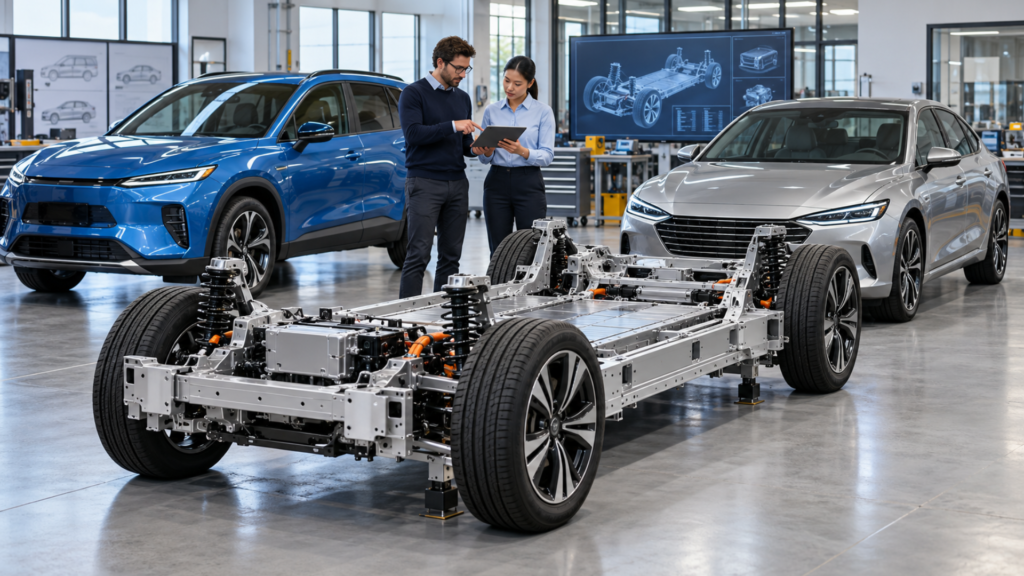
Car brands share platforms and components more frequently than many drivers realize. Two vehicles may have different designs, prices, interiors, and brand identities while using some of the same structural foundations or mechanical parts.
This practice does not necessarily mean that the vehicles are identical. A shared platform can be adapted to create sedans, crossovers, sport utility vehicles, electric cars, and other models with noticeably different characteristics.
1. What Is a Vehicle Platform?
A vehicle platform is the basic engineering architecture used to develop one or more models. Depending on the manufacturer, it may include structural elements, mounting points, suspension layouts, electrical systems, powertrain placement, and other underlying components.
Modern platforms are often modular. This means engineers can adjust dimensions such as wheelbase, width, body length, battery capacity, or suspension configuration while retaining selected common elements.
The result is a technical foundation that can support several vehicles instead of being designed for only one model.
2. Why Car Brands Share Platforms
Developing a completely new vehicle architecture requires extensive engineering, testing, manufacturing preparation, and supplier coordination. Using a shared platform allows an automotive group to distribute some of that work across several models.
It can also help manufacturers simplify production, use compatible components, and introduce new vehicles more efficiently. Savings may be invested in areas such as safety technology, software, electric powertrains, interior design, or manufacturing improvements.
For example, Volkswagen has used its Modular Transverse Toolkit, known as MQB, as the technical foundation for numerous vehicles. Toyota New Global Architecture, or TNGA, also supports multiple vehicle configurations. Stellantis has developed STLA platforms designed for vehicles from several of its brands.
3. Shared Platforms Do Not Create Identical Cars
A platform provides a starting point, but it does not determine every aspect of a vehicle. Manufacturers can make substantial changes to the body, suspension tuning, steering, engine or motor, sound insulation, seats, technology, and cabin materials.
One model may prioritize comfort and quiet driving, while another vehicle using a related architecture may emphasize performance, passenger space, off-road ability, or efficiency.
Brand-specific design and engineering decisions can therefore produce different driving experiences even when some underlying components are related.
4. Which Parts May Be Shared?
The number and type of shared parts depend on the manufacturer and vehicle program. Common components may include:
- Engines, electric motors, or transmissions.
- Suspension and steering components.
- Electrical modules and sensors.
- Infotainment hardware or software.
- Climate-control components.
- Switches, controls, and interior mechanisms.
- Structural or battery-related elements.
A shared part may have a different appearance, calibration, or part number depending on the model. Drivers should not assume that two components are interchangeable simply because the vehicles use a related platform.
5. Potential Advantages for Drivers
Shared engineering can provide several practical benefits. Components used across many models may have a larger supply network and may be familiar to more repair professionals.
Manufacturers can also refine a platform over time as it is introduced across additional vehicles. Common testing and production experience may help identify areas that require improvement.
However, availability and repair costs still depend on the specific model, location, warranty, component, and production volume. A shared platform does not automatically guarantee inexpensive maintenance.
6. Are There Possible Disadvantages?
Problems involving a widely used component may affect more than one model or brand. Nevertheless, recalls and service campaigns are normally based on specific vehicles, production dates, equipment, and identification numbers—not merely on the name of a platform.
Shared architecture can also make some vehicles appear technically similar, but important differences may remain. One model may include stronger brakes, different suspension settings, additional safety equipment, or a more powerful cooling system.
For this reason, comparisons should be based on the exact model year and configuration rather than assumptions about corporate relationships.
7. Does a Shared Platform Reduce Brand Identity?
Automotive companies use exterior styling, interiors, technology, suspension tuning, marketing, and customer experience to distinguish their brands. Some emphasize affordability and practicality, while others focus on luxury, performance, utility, or outdoor capability.
Two models can therefore share engineering resources without offering the same experience. The platform is only one part of the complete vehicle.
Drivers interested in how manufacturers position their vehicles can also explore our Car Brands articles.
8. What Should Buyers Check?
Compare the actual vehicles using our guide to evaluating car brands beyond reputation; shared architecture does not establish identical equipment or ownership costs.
When researching a vehicle built on a shared platform, consider the features that affect actual ownership:
- The exact engine, transmission, or electric powertrain.
- Standard and optional safety equipment.
- Suspension and wheel configuration.
- Passenger and cargo space.
- Warranty coverage.
- Maintenance requirements and parts availability.
- Recall history for the exact model and year.
A professional inspection remains important when purchasing a used vehicle. Shared components do not reveal how a particular car was driven, maintained, repaired, or stored.
A Specific Example: Golf VII and Third-Generation Audi A3
Volkswagen’s 2022 history of the MQB platform identifies the third-generation Audi A3 as the first MQB production model in the Group, followed by the Golf VII in 2012. These generation names matter: a shared model name across decades does not prove that every version uses the same architecture.
The example shows how different brands can use one modular engineering basis. It does not mean that their body panels, software, brakes, suspension settings, or safety ratings are interchangeable. For a repair, confirm the exact VIN, part number, engine, drivetrain, and manufacturer fitment information.
When comparing the vehicles, assess the actual equipment and condition using our model-by-model comparison method. When buying replacement components, distinguish OEM and aftermarket parts from platform compatibility.
A shared platform can outlast an individual model. Our guide to why car manufacturers discontinue models explains how demand, production costs, and platform changes can affect a vehicle’s future.
Final Thoughts
The fact that car brands share platforms is a normal part of modern vehicle development. Modular engineering allows manufacturers to create different models while reusing selected structures, systems, and components.
Drivers should evaluate the complete vehicle rather than judging it only by its platform or corporate relationship. Design, equipment, tuning, maintenance history, and manufacturing details can make closely related vehicles feel and perform very differently.
This article provides general educational information. Platform use, equipment, specifications, and component compatibility can vary by manufacturer, model, trim, market, and production date. Confirm information with the vehicle manufacturer or a qualified automotive professional.